Flexilink — Deterministic, Secure-by-Design Non-IP Networking
A clean-slate Layer 2/3 network architecture delivering guaranteed latency, security-by-design, and deterministic bandwidth for critical infrastructure.



What is Flexilink?
Flexilink is a non-IP networking architecture that replaces IP’s insecure best-effort forwarding model with a secure, authenticated, data plane that also offers a strictly deterministic and time-division-based service. Unlike TCP/IP — which was designed for resilient, best-effort communication — Flexilink is engineered from the ground up for systems where latency guarantees, security, and predictability are non-negotiable.
Layer 1 (the physical medium — fibres, cables, wireless) remains unchanged. Flexilink replaces Layers 2 and 3, while upper-layer application protocols continue to operate normally above it. Session establishment may evolve to take full advantage of the new guarantees offered.
Technical lineage
Flexilink builds on early work from Nine Tiles’ Brunhilde system, which demonstrated coexistence of guaranteed real-time service and best-effort service on shared physical media. Flexilink extends this concept in a modern non-IP architecture. See this (external source, local copy) for more details of Flexilink as an evolution of AES51/ATM-era deterministic media networking that carries scheduled AV traffic and best-effort IT traffic on the same Ethernet link using slot-based framing.
Why not just use IP?
IP networking carries fundamental design compromises that cannot be patched away:
| Property | IP / TCP | Flexilink |
|---|---|---|
| Forwarding model | Best-effort, variable latency | Assigned slots for time-critical traffic; Best effort for non-deterministic traffic |
| Security | Bolt-on (TLS, IPSec, firewalls) | Security-by-design at flow setup |
| Bandwidth waste | Header overhead, retransmissions | ≤1.6% overhead, no retransmissions |
| Attack surface | Large (routing table poisoning, DDoS, spoofing) | Minimal — no IP addresses, no ARP, no DHCP |
| Real-time suitability | Requires QoS workarounds (MPLS, TSN) | Native guaranteed service built in |
Key Performance Figures
| Metric | Value |
|---|---|
| Minimum measured latency | 65 μs (high-resolution audio) |
| Maximum bandwidth utilisation | 97.6% |
| Guaranteed service overhead | ≤ 1.6% |
| Allocation period range | 0.5 ms – 32 ms (configurable) |
| Link speeds supported | 1 Gb/s (current); 10 Gb/s planned, and others |
| Physical layer | Unchanged — runs over existing fibre/Ethernet/wireless (conditional) |
Architecture
Flexilink separates network traffic into two services, carried simultaneously over the same link:
- Guaranteed Service (AV: Audio Visual Traffic) — time-division slots reserved at connection setup; deterministic delivery, fixed latency, used for audio, video, real-time control
- Basic Service (IT: Best-Effort IT Traffic) — best-effort traffic (legacy IP, management, low-priority data) carried in unused slot gaps
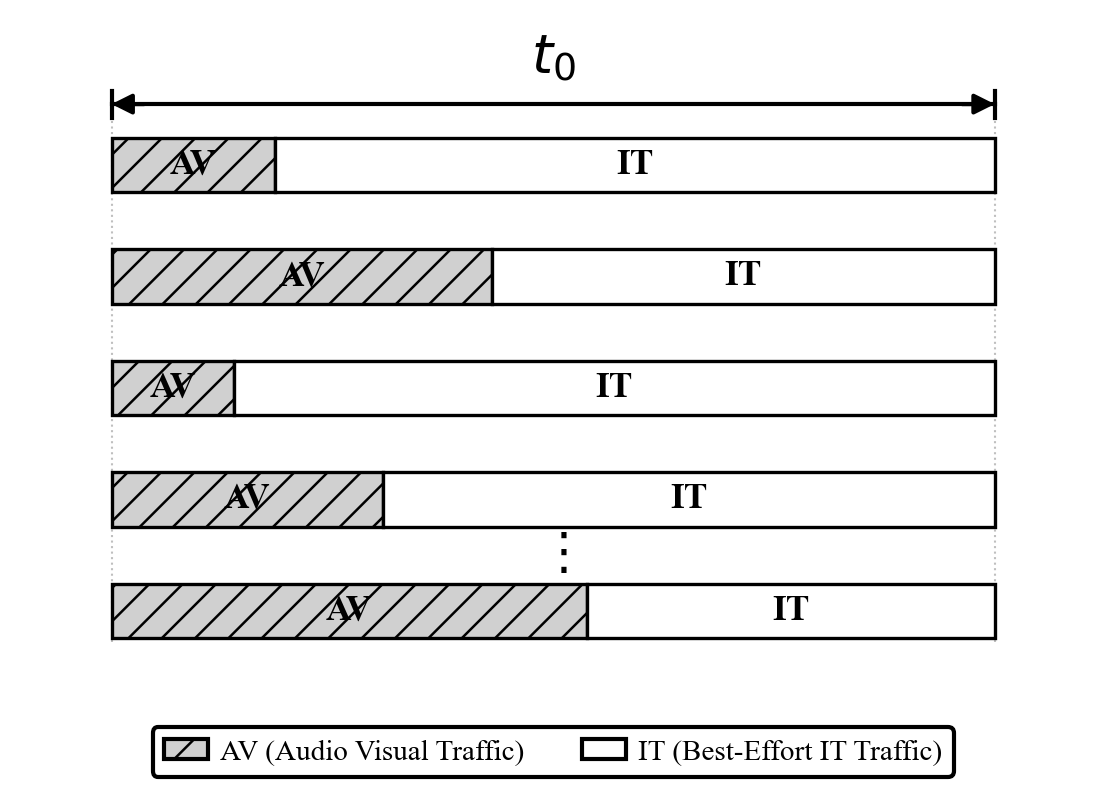
Figure 1: Flexilink slot allocation over a fixed period t₀ — Guaranteed Service (AV: Audio Visual Traffic) is transmitted at a fixed rate with variable-length frames occupying reserved slots each period; Basic Service (IT: Best-Effort IT Traffic) fills the remaining available bandwidth slots.
How guaranteed slots work
Each allocation period (configurable, typically 1 ms at 1 Gb/s ≈ 1,952 slots) acts as a repeating schedule window. Reserved flows are assigned fixed slot positions that repeat every period. The router forwards each slot purely by its position — no per-packet address lookup, no congestion, no jitter.
Hardware Prototype — The Aubergine Switch
Flexilink has been fully implemented and demonstrated on the Aubergine FPGA-based switching platform.
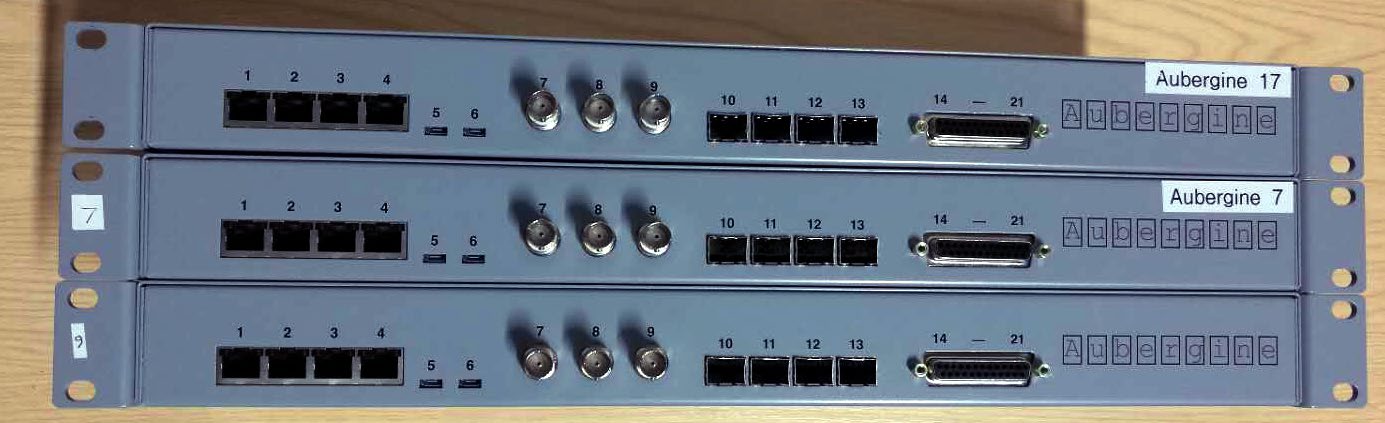
Figure 2: Three Aubergine Flexilink switches (rack-mount, 1U) used in the BCU research laboratory.
Aubergine specifications
- FPGA: Xilinx Spartan 6 SLX45T
- Ports: 4× 1 Gb/s Ethernet, 4× SFP (fibre), 4× AES3 digital audio in/out, 1× AES10 (MADI, 64 channels), SDI video, word clock input
- Soft CPU: TeaLeaves VM4 — a 32-bit stack processor running in FPGA fabric
- Management: “IEC 62379 Common Control Interface
FPGA Internal Architecture
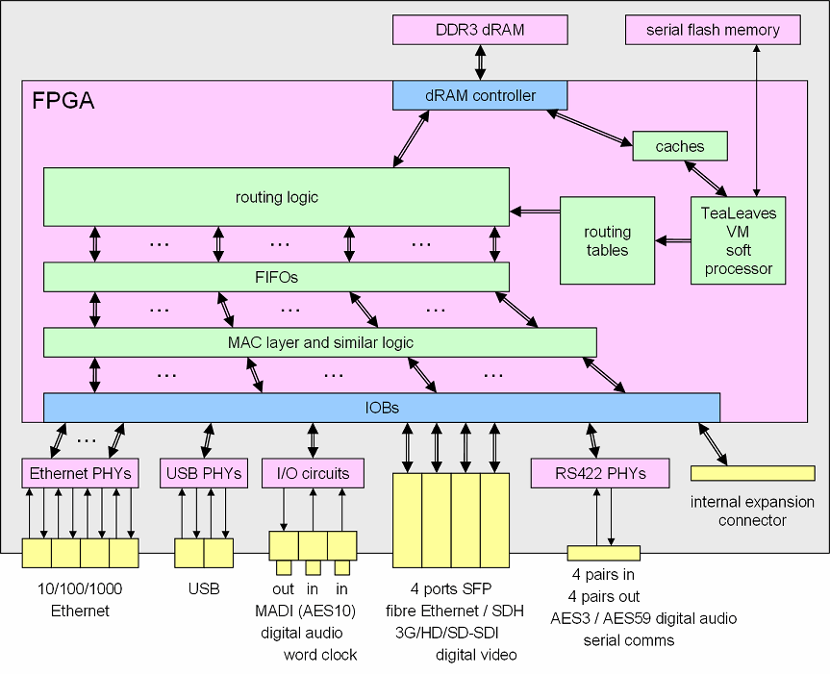
Figure 3: Aubergine FPGA block diagram — routing logic, per-port FIFOs, MAC layer, TeaLeaves VM soft processor, all within a single Spartan 6 FPGA.
PCB Layout
Figure 4: Aubergine Flexilink switch PCB layout — the physical implementation of the Flexilink switching hardware, housing the Xilinx Spartan 6 FPGA, DDR3 memory, Ethernet/SFP interfaces, and AES3/AES10 audio I/O on a single board.
Laboratory Setup
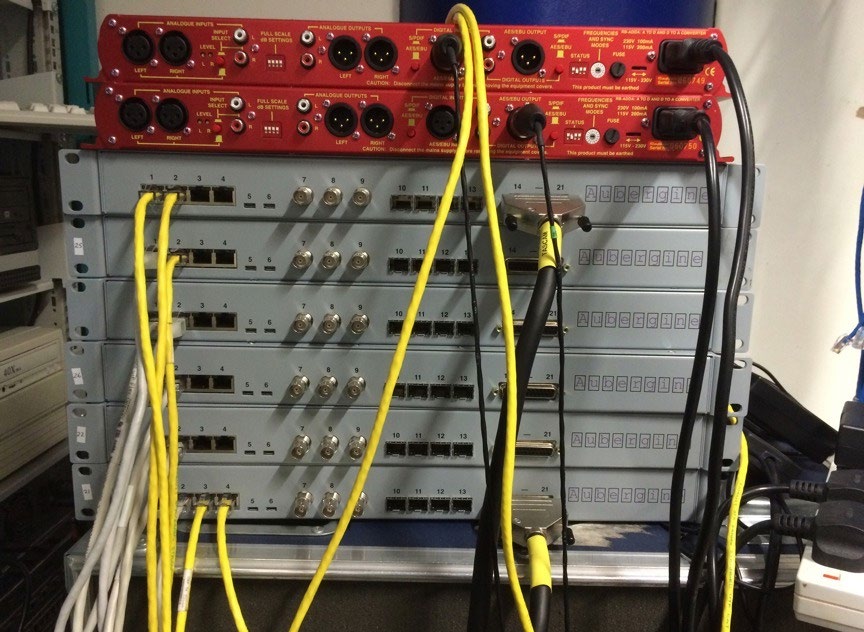
Figure 5: BCU laboratory rack — multiple Aubergine switches interconnected with AES3/AES10 professional audio equipment for live latency and determinism testing.
Applications
Flexilink is designed for any system where determinism, security, and low latency are critical requirements:
Critical National Infrastructure (CNI)
- Energy / Smart Grid — IEC 61850 GOOSE/Sampled Values messages have ≤ 4 ms latency requirements; Flexilink’s 1 ms allocation period meets this natively without QoS workarounds. Currently under investigation for UK distribution network operators (DNO) through an Innovate UK SIF bid.
- Industrial control (OT/ICS) — deterministic delivery eliminates timing uncertainty in SCADA and control loops
- Remote surgery / tactile networking — round-trip latency of < 1 ms demonstrated
Professional Media
- Live broadcast audio — AES3/AES10 (MADI) transport with measured latency of 65 μs; demonstrated with up to 64-channel MADI
- HD/4K video — SDI transport at up to 3 Gb/s via SFP modules
- Broadcast infrastructure — directly replaces AES67 audio-over-IP with guaranteed delivery
5G / 6G Backbone and Wireless
- DECT-2020 NR — Flexilink over DECT-2020 wireless defined in ETSI GS NIN 004
- Heterogeneous networks — mobility handover with deterministic re-routing; wireless PHY integration defined
Software-Defined Control — TeaLeaves and TeaLogics
The Flexilink control and forwarding functions are built with two distinct languages from the same language family:
- TeaLeaves defines software behaviour executed by the VM4 soft processor inside the FPGA (for example: routing updates, signalling, and admission control) without full FPGA recompilation
- TeaLogics shares the same core syntax but adds hardware-oriented constructs to describe FPGA implementations of VM internals and forwarding/data-plane functions
- A compiler toolchain can target either VM4-executed code or synthesisable FPGA logic, depending on which parts are best realized in software or hardware
The Flexilink Controller (Windows application) provides a graphical interface for configuring switches, monitoring flows, and viewing live network state.
Standards & Collaboration
Flexilink is developed in close alignment with international standardisation:
| Standard |
|---|
| ISO/IEC 62379 |
| ETSI GS NGP 013 |
| ETSI GS NIN 005 Flexilink signalling |
Collaboration enquiries are welcome from energy network operators, telecom providers, broadcast engineers, security researchers, and academic institutions.
GitHub Organisation
All publicly available Flexilink materials are hosted under the flexilink GitHub organisation:
| Repository | Contents |
|---|---|
| flexilink-controller | Windows Controller binaries (v2.1.2, v3.0.2, v3.1.0c), Controller C++ source, Wireshark plugin for Flexilink frame analysis |
| flexilink-docs | Research documentation and technical project materials |
| flexilink.github.io | Source for this website |
Relevant Standards documents
Published ETSI NIN/NGP relevant standards are available:
- GR NIN 001 — Non-IP Networking (NIN); Problem statement: networking with TCP/IP in the 2020s
- GR NIN 002 — Non-IP Networking (NIN); Implementing Non-IP networking over 3GPP cellular access
- GR NIN 003 — Non-IP Networking (NIN); Flexilink network model
- GS NIN 005 — Non-IP Networking (NIN); Signalling messages and protocols
- GS NIN 006 — Non-IP Networking (NIN); Scenario Definitions of Next Generation Protocols (NGP)
- GS NGP 013 — Next Generation Protocols (NGP); Flexilink: efficient deterministic packet forwarding in user plane for NGP; Packet formats and forwarding mechanisms
Selected Publications
-
Wang, Yonghao, John Grant, and Jeremy Foss. Flexilink: A Unified Low Latency Network Architecture for Multichannel Live Audio. AES Convention 133, 2012. PDF
-
Ma, T., Y. Wang, W. Hu, D. El-Banna, and K. Zhang. Performance Evaluation of a New Flexible TDM Protocol on Mixed Traffic Types. IEEE AINA, 2017. PDF
-
Ma, Tianao, Wei Hu, Yonghao Wang, Dalia El-Banna, John Grant, and Hongjun Dai. Evaluation of Flexilink as Deterministic Unified Real-Time Protocol for Industrial Networks. IEEE TrustCom/BigDataSE, 2018. PDF
-
Ma, T., Y. Wang, W. Hu, D. El-Banna, and K. Zhang. Evaluation of New Dynamic TDM Protocol for Real-Time Traffic over Converged Networks. IEEE FiCloud, 2018. PDF
-
Guo, Yi, Jing Liu, Yonghao Wang, and Wei Hu. Short Cycle Conversion Scheduling Model for Flexilink Architecture. IEEE HPCC/SmartCity/DSS, 2019. PDF
-
Ma, Rongxuan, Yonghao Wang, Wei Hu, and Mahir Payyanil Karalakath. Evaluation of Video Payload over Low Latency Networks: Flexilink. International Journal of Parallel, Emergent and Distributed Systems 35(3), 2020. PDF
Recent Updates
- April 2026 — New hardware development document published; FPGA platform expansion (Achronix, Microchip) under evaluation for next-generation switches.
- March 2026 — Flexilink Controller v3.1.0c released; Controller source code and Wireshark plugin made publicly available.
Contact
For collaboration, demonstrations, or technical briefings:
| Dr Yonghao (Leo) Wang | Birmingham City University |
| yonghao.wang@bcu.ac.uk | |
| John Grant | Nine Tiles, Cambridge — Inventor & Lead Engineer |
| j@ninetiles.com |
- Nine Tiles — Cambridge, UK
- Birmingham City University — Faculty of Computing